

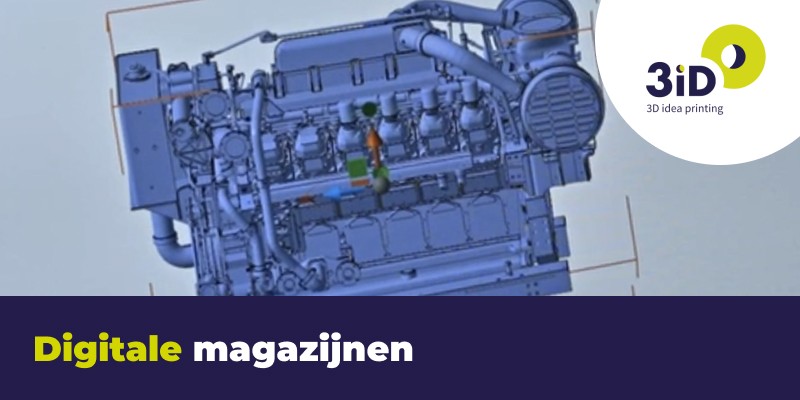
Digital warehouses do not store physical spare parts but keep 3D files that are printed on-demand when needed, without inventory and waste. This approach eliminates the problem whereby thousands of spare parts gather dust in warehouses for years and are destroyed after the legally mandated period.
Manufacturers are legally required to keep spare parts available for a number of years. From a consumer protection standpoint, that makes sense. How they do it can be improved. Today, thousands of spare parts gather dust in warehouses. After the legal period, they are destroyed. It is a significant form of waste. 3iD once started from a different idea: digital warehouses. What if manufacturers do not store physical parts, but 3D files? What if spare parts are printed on-demand when they are needed? No inventory. No waste.
That idea was at the foundation of the establishment of 3iD. And it remains something we believe in.
How Do Digital Warehouses Work as an Alternative to Physical Inventory?
With a digital warehouse, a manufacturer stores the 3D file of each spare part. A client orders a specific part. A print partner such as 3iD produces it on-demand and delivery follows a few days later. The part is identical to the original. Physical inventory is not necessary; no capital is tied up in pieces that may not be sold.
* On-demand production means that parts are only produced at the moment there is demand for them, instead of building up large inventories in advance.
Advantages:
- No storage costs: you have no warehouses full of parts that will later be destroyed
- Less waste: no investment in inventory that may never be sold
- Sustainability gain: smaller waste pile and no pointless transport
Why Are Digital Warehouses Not Yet Standard?
Today it is (still) cheaper to make that legally required inventory and let it gather dust. Existing production processes are designed for large series. Injection molding machines produce thousands of identical parts efficiently. Storing that inventory costs money, but it is a known cost. Depreciable, within systems, procedures, and habits built around it.
Digital warehouses require a different way of thinking. Systems must be restructured as digital inventories. Partnerships with print suppliers set up. Logistics adapted. That requires (relative) investments in processes and organization.
Legal obligations do not yet prescribe digital inventories. They only require that spare parts be available. How that happens, legislation leaves open. Companies fall back for convenience on what they know: physical inventory in warehouses. The familiar paths.
Old habits die hard. That applies to sectors, but also to individual companies. Change takes courage. A new way of working requires trust. Digital warehouses are not a mainstream solution. Not yet.
Which Companies Are First to Discover the Potential of Digital Warehouses?
Machine building and automotive are the logical frontrunners in the adoption of digital warehouses. In both sectors, products last for decades, parts are very diverse, and spare parts are ordered sporadically and unpredictably.
The sectors moving fastest:
- Machine building: the machines last for decades, parts are sporadically replaced
- Automotive: has an immense diversity of parts, long lifespan of vehicles
- Industrial equipment: long product life cycles where some parts are rarely or never ordered
Companies see the advantages of on-demand production. Of a circular economy that goes beyond pure recycling. Of flexible supply chains that are not tied to a physical inventory. Some sectors move faster than others.
3iD sees that evolution: on-demand solutions and spare parts printed when there is demand for them are a meaningful economic and logistical consideration. That shift is slow. An evolution is not a revolution. Companies test, pilot projects run, and confidence grows. Step by step.
What Is the Role of 3iD in This?
The idea of digital warehouses was, twenty years ago, part of the foundation of 3iD. As a vision for the future, which has today become a real possibility. The potential is there, therefore. Digital warehouses are not science fiction. They are a workable solution to a real problem.
Will we ever evolve toward a fundamentally different way of managing inventory? Toward a system where parts exist digitally until they are physically needed? Where waste decreases and flexibility increases?
We like to believe so. Because it is possible. Because the advantages are clear. Because there is vision in it, and the willingness to deal sustainably and sensibly with raw materials and resources.
Wondering whether rapid prototyping via 3D printing is worthwhile for your project?
Contact 3iD at info@3idprinting.be or visit www.3idprinting.be
Frequently Asked Questions about Digital Warehouses
How do digital warehouses work?
A manufacturer stores the 3D file of each spare part. A client orders a specific part. A print partner such as 3iD produces it on-demand. Delivery follows a few days later and the part is identical to the original.
Why is this not happening everywhere yet?
Today it is cheaper to make that legally required inventory and let it gather dust. Systems are not set up for digital inventories. Old habits die hard.
Which sectors are moving fastest?Machine building, where machines last for decades and parts are sporadically replaced, is a logical candidate. Automotive, with its immense diversity of parts and long lifespan of vehicles, likewise.
What are the advantages?
On-demand production eliminates storage costs. No capital tied up in pieces that may never be sold. Flexibility increases and the sustainability gain is enormous.
When will this become mainstream?Companies test, pilot projects run, and confidence grows. Step by step. An evolution is not a revolution.